

How SASE Can Support Digital Transformation: Benefits, Trade-offs, and Readiness
Assess how SASE may support changing applications, distributed users, and cloud adoption, including the organisational readiness and service trade-offs that determine whether it fits.
By Mark Poulton
How SASE Can Support Digital Transformation: Benefits, Trade-offs, and Readiness
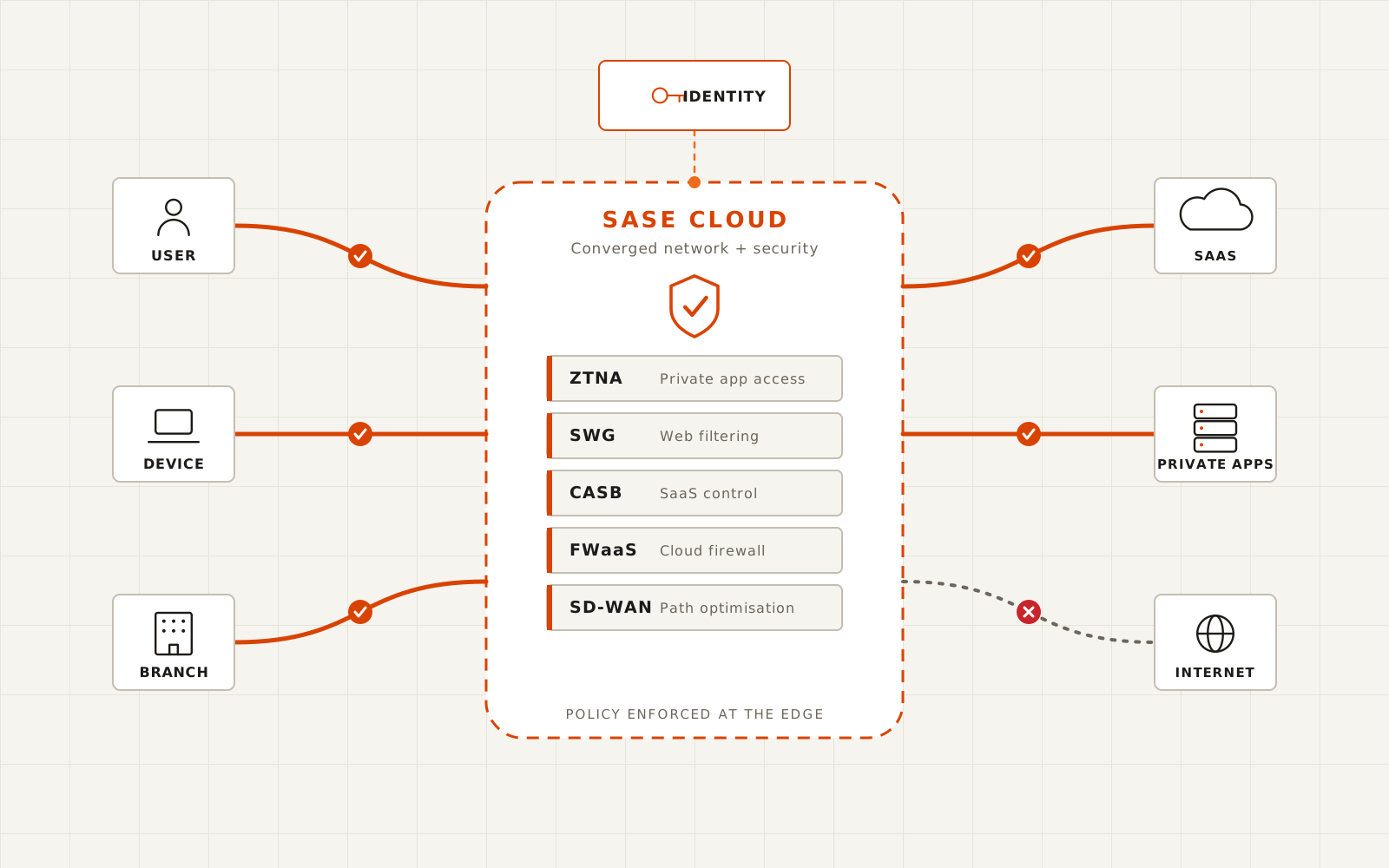
SASE can support digital change when an organisation needs to coordinate access for people, sites, and applications that no longer sit behind one network perimeter. It may help align connectivity, identity, and cloud-delivered security across those paths. It does not create a digital transformation strategy, and it does not guarantee simpler operations, lower costs, stronger security, or better performance.
The SASE fundamentals article defines the architecture and its relationship to SSE and SD-WAN. The practical question here is narrower: where might the model help an organisation change how it delivers services, and what must be true for the change to work?
Which kinds of change can SASE support?
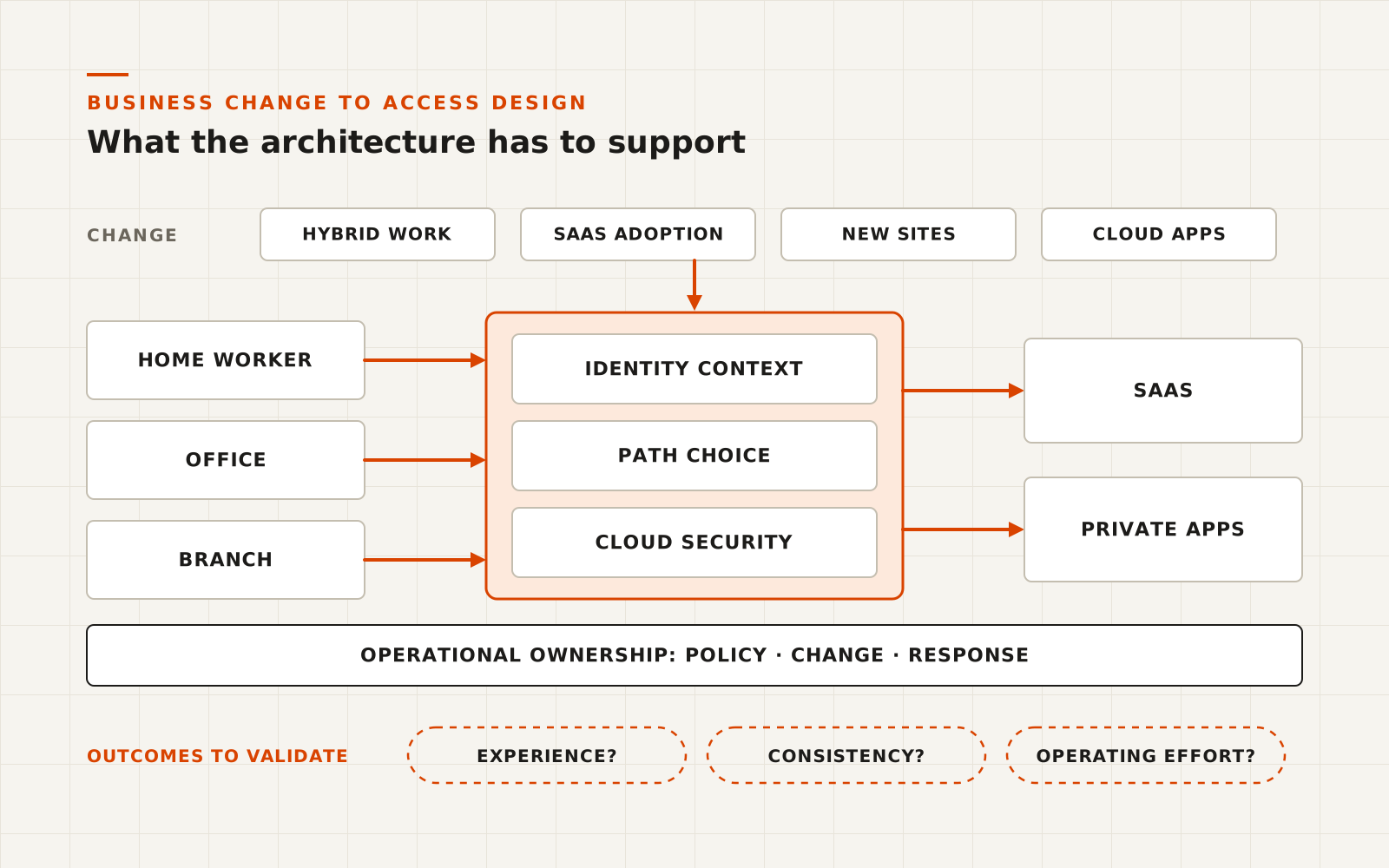
The case is strongest when a business change creates a specific access or operating requirement. SASE is one possible way to address that requirement; it should be compared with improving existing services or adopting a narrower capability.
| Change in the organisation | Potential SASE contribution | What to validate |
|---|---|---|
| Applications move between data centres, SaaS, and public cloud | Coordinate access policy and routing across different destinations. | Application paths, inspection requirements, dependencies, and performance from user locations. |
| More work happens across offices, homes, and partner environments | Apply access decisions using identity and available device context beyond a single site perimeter. | Identity lifecycle, device coverage, exception handling, and support for each user group. |
| Security and networking teams manage overlapping services | Bring selected network and security policy into a more coordinated service model. | Whether integration actually removes duplicate tasks or creates new provider hand-offs and policy boundaries. |
| New locations or services need to be connected | Use provider-delivered capabilities where they meet the access, resilience, and operational requirements. | Service availability at the required locations, dependencies, contract terms, and exit options. |
These are hypotheses to evaluate, not guaranteed SASE outcomes. Cloud delivery may reduce the need to deploy some functions at every location, but it can introduce provider dependencies, subscription costs, new integrations, and different troubleshooting paths.
What business value should be tested?
Start with a business workflow or service outcome, then identify the access issue that affects it. For example, if a new SaaS application is difficult to support across offices and remote users, map the routes, policy checks, and support hand-offs today. A proposed SASE design should show how that path changes and what evidence will demonstrate a useful improvement without weakening required controls.
Potential value areas include more consistent policy across locations, fewer unnecessary traffic detours, less repetitive configuration, or clearer operational visibility. Measure each against the existing process. A consolidated service does not automatically mean fewer tools or lower total cost; licensing, migration overlap, skills, provider management, integration, and retained legacy controls all matter. Likewise, a cloud security point does not prove a security outcome unless the relevant traffic is covered and the control is configured, monitored, and owned.
The SASE remote-work article examines user and application paths in more detail. For site connectivity and traffic steering, see the SD-WAN Deep Dive; SASE may use SD-WAN, but the two terms describe different scopes.
When is SASE a reasonable strategic option?
SASE may merit evaluation when several user or application paths cross offices, home networks, SaaS, private applications, or cloud services and current controls are difficult to coordinate. A clear owner should be able to state what is not working today, which users and resources are affected, which controls must remain, and what evidence would justify changing the service model.
It may not be the right next step when the existing architecture already meets the requirements, the problem is confined to one application or access path, or organisational teams cannot yet operate a broader service. Regulatory or data-handling constraints, provider reach, latency-sensitive applications, legacy dependencies, contracts, and internal support skills can all change the decision. A smaller targeted improvement may be more proportionate.
Is the organisation ready to evaluate SASE?
Before procurement or rollout, establish readiness in several areas:
- Business ownership: Name the outcomes and accountable owners across networking, security, identity, applications, and service operations.
- Access and application knowledge: Map important users, devices, applications, hosting locations, protocols, and existing paths; record unknowns rather than filling them with assumptions.
- Security and identity foundations: Confirm identity sources, device signals, policy ownership, logging, exception handling, and incident response.
- Service and operational constraints: Check provider coverage, resilience, integration, support boundaries, contracts, data handling, and how the service can be changed or exited.
- Evidence and economics: Baseline current experience and operating effort; compare full lifecycle costs and define how expected benefits will be measured.
Readiness is not a demand to complete a large transformation programme before testing anything. It is a way to select a bounded, meaningful use case and know what must be true before expanding it. The SASE implementation and architecture article covers assessment, design, piloting, and staged rollout. The SD-WAN-to-SASE transition article owns the specific migration decision, while SASE vendor evaluation compares providers against declared requirements.
Conclusion
SASE can be an enabling part of digital change when access patterns, application locations, and security responsibilities are changing together. Its strategic value depends on the organisation's actual use cases, integration and operating readiness, service trade-offs, and evidence of outcomes. Evaluate the problem first; adopt SASE only if it is a better fit than the existing design or a narrower alternative.