

SD-WAN: How It Works and When It Fits
A practical introduction to SD-WAN: how it routes traffic, which problems it can solve, and the trade-offs to weigh before adopting it.
By Mark Poulton
What is SD-WAN and how does it work?
SD-WAN (software-defined wide-area networking) is an approach to connecting geographically distributed sites that uses centrally managed software policies to steer traffic across one or more network connections. It separates the policy and management of traffic from the individual circuits carrying it, so teams can apply consistent rules across branches, data centres, cloud services, and users.
SD-WAN is not a particular circuit, security product, or guarantee of faster and cheaper networking. It is an overlay and operating model whose results depend on the available connections, traffic patterns, policy choices, security controls, and the team's ability to run it.
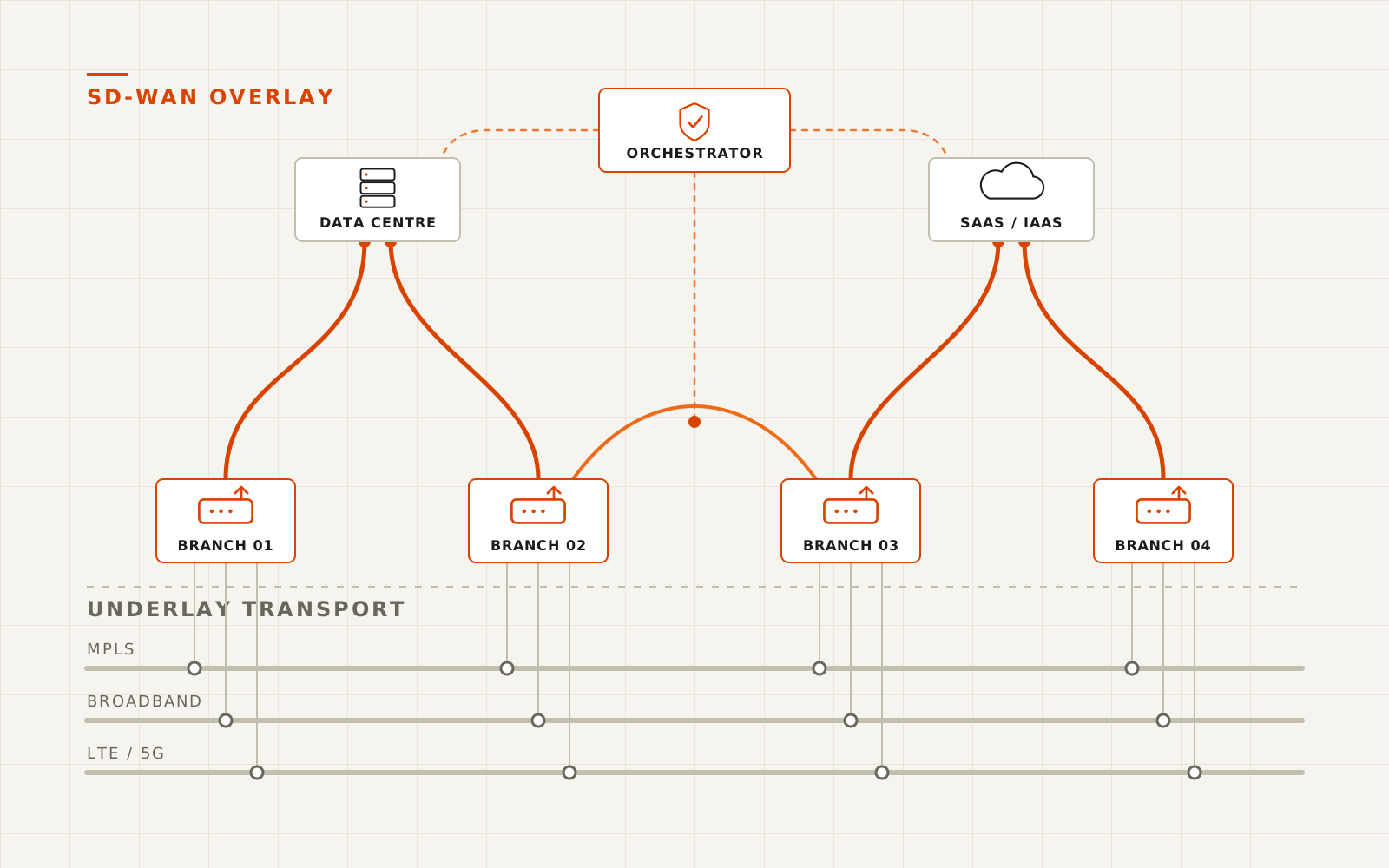
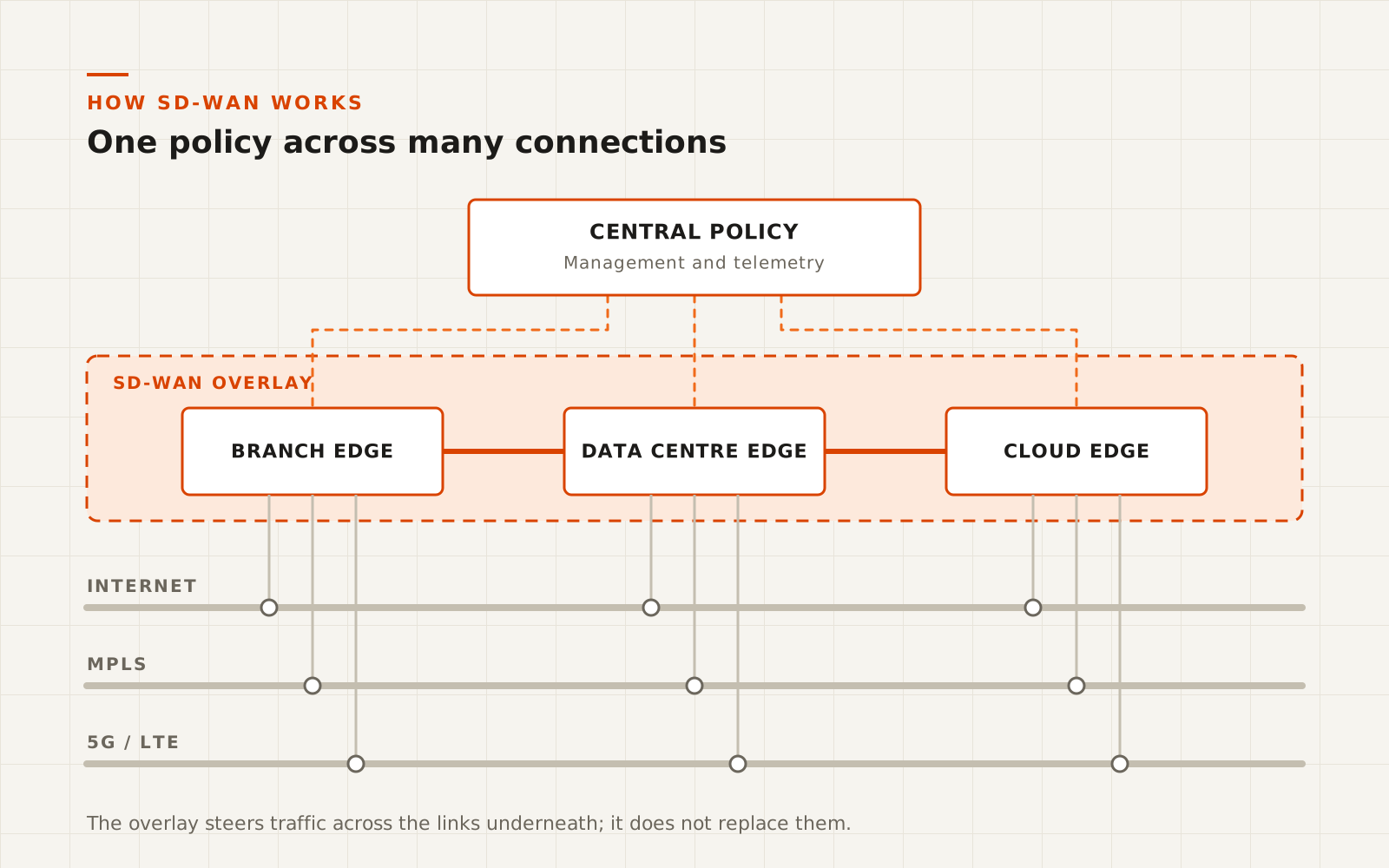
In practice, an SD-WAN edge device or virtual edge is placed at a connected location. The edges use centrally defined policies to identify traffic and choose an available path. The underlying connections may include internet broadband, dedicated circuits, cellular service, or a mixture of them. The software-managed overlay coordinates how traffic moves across those links; it does not replace the links themselves.
A policy might prefer a path with suitable conditions for a voice or video session and allow less time-sensitive traffic to use another connection. The edge can consider configured application rules and observed link conditions, then move traffic when a path no longer meets policy. The exact signals, path-selection behaviour, failover time, and available controls vary by implementation.
Management and telemetry give network teams a shared view of policies, sites, and link health. That can make changes more consistent than configuring every branch independently, but it does not remove the need to understand routing, application dependencies, security boundaries, or the physical circuits underneath.
What problems does SD-WAN solve?
Traditional wide-area networks were often designed around traffic flowing between branches and a central data centre. As more applications moved to SaaS and public cloud services, sending branch traffic through a central location and back out to the internet could add unnecessary routing steps. A distributed workforce and a growing number of sites also made per-location changes and troubleshooting harder to coordinate.
SD-WAN can help when an organisation needs to:
- manage several types of connection through a consistent policy model;
- steer different applications according to business and network requirements;
- connect branches more directly to cloud or internet services where the security design permits it;
- gain a consolidated view of link and application-path conditions; or
- apply configuration changes across many locations with less manual repetition.
These are problems it can help address, not automatic outcomes. A congested access circuit remains congested. An application may still perform poorly because of its service, endpoint, or destination. Central policy can also spread a mistake quickly if changes are not tested and controlled.
What are the key components of SD-WAN?
The exact product architecture varies, but most deployments involve a few recurring concepts:
| Component | What it does |
|---|---|
| SD-WAN edge | Connects a site, data centre, cloud environment, or user into the managed network. |
| Underlay connections | The circuits and access networks that carry traffic, such as broadband, cellular, or private WAN links. |
| Controller or orchestrator | Distributes configuration and policy and coordinates the managed overlay. Its role and placement vary by service. |
| Traffic and security policy | Defines which traffic is identified, where it may travel, and what controls apply. |
| Management and telemetry | Shows configuration, link conditions, and operational events so teams can review and troubleshoot the service. |
This is a vocabulary for understanding the service, not a reference architecture. Detailed control-plane choices, topology, redundancy, and integration belong in the SD-WAN architecture article and the design considerations article.
What are the benefits of SD-WAN?
The practical benefits are conditional on a good fit between the technology and the network problem:
- More flexible transport choices. A team may combine private and internet connections instead of relying on a single circuit type everywhere. Whether that reduces total cost depends on circuit prices, support, redundancy, licensing, and operations.
- Application-aware traffic policy. Traffic can be treated according to the needs assigned to it, rather than routing every flow by the same site-level rule. This improves control, but cannot create capacity or fix an unhealthy application.
- Consistent management across sites. Central policy and templates can reduce repeated configuration work. They also make change review, staged rollout, and rollback important.
- More direct cloud access when appropriate. Local internet breakout can avoid a central detour for selected services. It must be designed alongside identity, inspection, data protection, and incident-response requirements.
- A clearer operational view. Shared telemetry can help teams investigate path and link issues, provided the service exposes useful evidence and operators know how to interpret it.
Treat claims about savings, performance, or availability as hypotheses to test against a baseline. The right measure is the result for the applications and sites that matter, not a vendor's best-case headline.
For a deeper look at lifecycle cost and value, see the SD-WAN economics article; the measurement article covers how to assess outcomes against a baseline.
Limitations and trade-offs
SD-WAN adds policy and orchestration; it does not make the wide-area network simple by default.
- The underlay still matters. Internet service quality, local last-mile capacity, routing conditions, and provider support differ by location. A software overlay cannot guarantee consistent paths across networks it does not control.
- Resilience needs independent failure paths. Two links do not provide meaningful redundancy if they share the same duct, provider, power source, or upstream dependency. Failover must be tested against the failures the organisation actually needs to tolerate.
- Security is a design responsibility. Encryption and segmentation may be available, but capabilities differ. SD-WAN alone should not be assumed to provide every firewall, web, identity, endpoint, or cloud security control an organisation requires.
- Policy introduces operational risk. Application identification, prioritisation, exceptions, and changes need ownership and testing. Central administration can amplify both a correct change and a faulty one.
- Integration takes work. Existing routing, firewalls, identity, monitoring, service desks, and legacy applications may impose constraints. Staff need a clear operating model and enough skills to diagnose the complete path.
- Costs move rather than disappear. Circuit savings, where available, need to be weighed against platform subscriptions, support, security services, migration, and ongoing operations.
Security boundaries and control responsibilities are covered in more depth in the SD-WAN security article. Deployment dependencies and rollout risks belong in the SD-WAN deployment article.
SD-WAN and traditional WAN
The useful comparison is not “new versus old”; it is whether a proposed service better fits the organisation's traffic, control, resilience, and operating requirements.
| Consideration | Traditional WAN pattern | SD-WAN pattern |
|---|---|---|
| Traffic control | Often tied closely to circuit and site routing design. | Policy can classify and steer traffic across multiple connections. |
| Transport | May emphasize private circuits and provider-managed paths. | Can combine private and internet access, subject to design and service support. |
| Operations | Changes may be made separately across network devices and providers. | Central orchestration can standardize changes across sites. |
| Cloud access | May send cloud-bound traffic through a central point. | Can support direct access where policy and security allow it. |
| Trade-off | Predictable service characteristics may be valuable, with less path flexibility. | Greater policy flexibility brings platform, integration, and underlay dependencies. |
Many organisations retain a hybrid design. MPLS may still fit applications with specific service requirements, locations with limited internet options, or an existing contract that is not yet economical to replace. For the dedicated comparison, see MPLS versus SD-WAN.
When should an organisation consider SD-WAN?
SD-WAN may be worth evaluating when
- multiple sites use different connection types;
- application traffic needs differentiated treatment;
- cloud or internet traffic follows inefficient paths;
- centralised policy and visibility would address a meaningful operational need; or
- a network refresh provides a natural point to reconsider the WAN model.
These are prompts to investigate fit, not a scoring system or recommendation to adopt SD-WAN. Why consider SD-WAN? explains the reasons organisations may consider moving to it.
Before deciding, establish:
- which applications and user journeys have a measurable network problem;
- where traffic enters and leaves the WAN today;
- what service levels and failure scenarios matter at each site;
- which security controls must apply to each path; and
- the full operating and lifecycle cost of the current and proposed models.
Use those findings to test a bounded use case and compare it with the current service. Detailed design and rollout methods belong in the related design and deployment articles, not in this introduction.
Investigate further before adopting when
- the existing WAN already meets application and resilience requirements;
- local connectivity is fundamentally constrained;
- there is no meaningful WAN-management problem;
- the organisation cannot support policy ownership and incident response; or
- the lifecycle cost of change is not justified by the expected operational value.
When might SD-WAN not be the right choice?
It may not be the right answer when a small or stable network has no meaningful WAN-management problem, the existing service already meets application and resilience needs, or local connectivity is too limited for the proposed design. It may also be a poor fit when the organisation cannot staff policy ownership and incident response, when a critical application depends on a network path the service cannot control, or when the total cost of change exceeds the likely operational value.
In those cases, a targeted circuit upgrade, better monitoring, a simpler routing change, or retaining the current WAN may be more proportionate. The choice should follow the constraints and evidence, not a presumption that every network needs an overlay.
Where does SD-WAN fit with SASE?
SD-WAN addresses how traffic is connected and steered across locations and links. SASE (secure access service edge) describes a broader model that brings network connectivity together with cloud-delivered security capabilities. SD-WAN may provide the networking foundation of a SASE design, but the terms are not interchangeable, and an SD-WAN deployment does not automatically include every SASE capability.
For the broader model and its capability boundaries, see the SASE fundamentals article. This section is limited to how SD-WAN relates to SASE.
Key takeaways
- SD-WAN applies centrally managed software policy to traffic across a wide-area network.
- It can improve transport flexibility, application steering, and multi-site operations when those are real needs.
- Outcomes depend on link quality, architecture, security controls, integration, and operational discipline.
- SD-WAN is not universally cheaper, faster, more secure, or a replacement for every private circuit.
- Compare the full operating model with the current network before choosing it.